












創造の源泉へ。音楽芸術の源泉とは。
Column|2026.4.22
Text_kotaro sakata
有形物などは、残存放射性物質の半減期などからそのルーツを探りやすい。しかし、その創造者への想いを馳せると、無限の世界が広がる。ましてや、無形芸術の代表と言えば、『世界共通言語と言われる音楽芸術』だろう。では、その音楽のルーツを旅してみよう。起源は人類がホモサピエンスとして立ったときと言えるようだ。 ハミングの様なもの、または、祭り、祈りの儀式のときの『叫び』もルーツと言えよう。記録に残るものとしては、楽譜の起源はピタゴラス(紀元前572年頃~)まで遡ることが出来る。古代ギリシアの哲学や数学を創始した哲学者・科学者と言われており、『ピタゴラスの定理』で既知であろう。しかし、この記譜方法はいたって数学的音律であり、音楽の原点とは、言いにくい。明確に西洋音楽の原点は、グレゴリオ聖歌と言える。この聖歌は、9世~10世紀にかけて、フランク王国(主に西欧)で発展し、後に改変を受けながら伝承したもので、宮宰ピピン3世がメロヴィング朝を倒して開いたカロリング朝の歌にローマ帝国とガリアの聖歌を統合したものと言うのが定説だ。ちなみに、フランク王国の西は、後のフランスになるが、源を辿るとフン族に追いやられたゲルマン民族がルーツなので、今のドイツ、フランス、イタリア北部はある意味で同一民族と言えよう。
ですので、音楽の起源は、『歌』と言うことに収束する。現代音楽教育では、音楽は2つに大別され『歌=カンターレ』に対し『器楽曲=ソナーレ』となる。つまり、音楽は『歌系』か『楽器系』かの2つに大別されそうだ。そこから、暗黒の中世を経て、ルネサンス期となるわけだが、ルネサンスはなぜイタリア半島で始まったかというと、オスマン帝国がビザンツ帝国を滅亡させ、古代から続いて来たギリシアの知的層が、イタリア半島に押し出されて流入した。そして、16世紀イタリア半島・フィレンツェの知識人達(詩人、劇作家、音楽家、人文学者など)が、夜な夜な、フィレンツェの貴族ジョヴァンニ・デ・バルディ伯爵邸に集まり、古代ギリシ ア・ローマ文明のプラトンやアリストテレスの残した文献などから研究を重ね、古代ギリシア悲劇を復活させるため、様々な有形無形の総合芸術の創作がなされ、1596年にヤコボ・ペーリ作曲の音楽劇『ダフネ』が上演され、これが世界初のオペラ作品だといわれている。(楽譜は見つかっていない)続いて1600年には共作で『エウリディーチェ』が上演された。現存する最古の総合芸術『オペラ』の誕生である。
このクリエイティブグループの名を『カメラータ』といい、フィレンツェで花開いたということで、『カメラータ・フィオレンティーナ』と呼ばれている。メンバーには、ヴィンチェンツォ・ガリレイ(ガリレ オ・ガリレイの父で音楽理論家)、ヤコポ・ペーリ、ジュリオ・カッチーニ(作曲家)などがいたとされる。そして、彼らを庇護し支援した立役者が、メディチ家一族だ。
先祖は薬種問屋か医師であったとされており、メディスン(医療)の語源である。ルネサンス期のフィレンツェを拠点とした名門一族で、銀行家、商人として財を成し、政治の実権を握り、芸術や文化を保護し『芸術のパトロン』と呼ばれている。コジモ・デ・メディチに始まり、ロレンツォ・デ・メディチが最盛期と言われ、彼らのパトロン活動により、彫刻家:ミケランジェロや画家:ボッティチェッリらを擁護し、イタリア(半島)・ルネサンス文化を最盛期に導いたことで知られる。しかし、ロレンツオの長男ピエロの怠惰により、金融業が破綻し、弟のジュヴァンニは、ハプスブルク家に金の無心をし、教会によって贖宥状(免罪符)を発行することで、末には、金の力でロー マ教皇にまで上り詰めたジョヴァンニ(レオ10世を名乗る)まで腐敗する光と影の家系でもある。ルネサンスの黄昏時にオペラが生まれ、時、同じくして極東の日の本(日本:江戸時代)で歌舞伎が芽生えた。これはあまりにも偶然過ぎるシンクロニシティだ。
In search of creativity’s origins: Tracing the roots of musical art.
While physical artifacts reveal their roots through radioactive decay, the origins of intangible arts like music lead us into an infinite realm. As a “universal language,” music’s lineage traces back to the dawn of Homo sapiens—to primitive hums, rhythmic chants, and the sacred shouts of ancient rituals.
Historically, musical notation dates back to Pythagoras (c. 572 BC). Though the legendary mathematician laid the foundations of Western music theory with his numerical ratios, these were more mathematical constructs than artistic expressions. The true cradle of Western music lies in Gregorian Chant. Developed in the Frankish Kingdom during the 9th and 10th centuries, this tradition unified Roman and Gallic chants under the Carolingian Dynasty. Interestingly, the Germanic tribes who founded this kingdom later evolved into the modern identities of France, Germany, and Northern Italy, revealing a shared cultural heartbeat at the root of European history.
Ultimately, the essence of music converges in the “human voice.” Modern education categorizes music into two realms: cantare (song) and sonare (instrumental). Following the medieval period, the Renaissance ignited in Italy, fueled by an influx of Byzantine intellectuals fleeing the Ottoman Empire. These scholars brought with them the rediscovered wisdom of ancient Greece and Rome.
In 16th-century Florence, a circle of humanistsknown as the Camerata gathered at the home of Count Giovanni de’ Bardi. Their mission was to revive the grandeur of Greek tragedy, blending various arts into a single experience. This pursuit led to Jacopo Peri’s Dafne (1596), recognized as the first opera, and later Euridice (1600). These milestones marked the birth of opera—the oldest surviving “total work of art”—where the primal power of song finally met the sophistication of classical drama.
This creative collective is known as the Camerata de’ Bardi or Camerata Fiorentina. Its members included composer Jacopo Peri and music theorist Vincenzo Galilei—father of Galileo. Their revolutionary work was fueled by the patronage of the Medici family, whose name shares its roots with “medicine.”
As legendary bankers and patrons, the Medicis— from Cosimo to Lorenzo the Magnificent— shielded geniuses like Michelangelo and Botticelli, propelling the Renaissance to its zenith. Yet, the lineage was a tapestry of light and shadow; following Lorenzo’s death, financial decay and corruption took hold, leading Giovanni de’ Medici to ascend the papacy as Leo X through the sale of indulgences. Paradoxically, as the Renaissance waned, Opera was born in Italy just as Kabuki emerged in Edo-period Japan—a striking synchronicity of global cultural evolution.
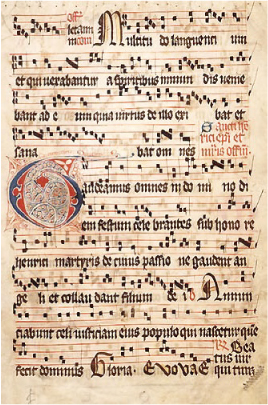
グレゴリオ聖歌の楽譜とされる:
14~15世紀に出来上がった、聖ヘンリクを讃えた、譜線入祭唱Gaudeamus omnes 「全てのものよ、喜ばん」との記載が読み取れる。