











日本(奈良)編
dumplings|2025.1.24
「旅する餃子」奈良編。
千三百年以上の歴史をもつといわれている古都。
そんな奈良の文化が息づいた餃子を創作することが今回のテーマ。
悠久の時を感じられる餃子はできあがるか?

長い歴史と洒落た今が共存する古都。
奈良、そこには千三百年の歴史が積み重なり、いたるところに古寺がある。町なかの何気ないお寺にも重要文化財級の仏像が置かれているから驚く。奈良の人々の日常には国宝級の建物や像がある。
しかし、奈良の人たちは控えめだ。先日、奈良の吉野で立ち寄った土産物店のおばさんは言った。「奈良は土くさいやろ。京都はきらきらしてるけど、それに比べて奈良は、もひとつパッとせえへんわ」と。いやいや、阿修羅像や十二神将像、鑑真和尚像、十一面観音像など、仏像女子や寺ガールの憧れの仏さんが多くいらっしゃる、奈良は素敵な所です。
歴史ある奈良にも新しい波が押し寄せている。奈良町と呼ばれているエリアには、町屋を改築したカフェやギャラリー、レストランが点在し、大人っぽくお洒落な雰囲気。若い人やインバウンドの観光客が多く、歩くだけでも楽しい。
では、奈良で何を食べるか?あまり思い浮かばないが、奈良漬けは全国で知られているだろう。なんと奈良の歴史と同じ千三百年前からある漬け物で、もとは貴族のための高級品だったという。
さらに奈良はジビエも多く食されていて、猪肉のぼたん鍋をはじめ、鹿肉を使った料理も人気となっている。ちなみに、奈良公園の鹿は神様のお使いなので食べてはならず、山間部の野生の鹿は貴重なタンパク源として古くから食べられていた。
そんな奈良をテーマに、今回の「旅する餃子」は奈良漬けとジビエという奈良の食文化を継承して創作された。
An ancient capital where long history and modern flair rub elbows.
Nara boasts 1,300 years of history, with ancient temples everywhere and Important Cultural Properties even in ordinary temples. Yet, the locals are surprisingly modest; an elderly woman in Yoshino told me Nara is “unrefined” compared to “glittering” Kyoto. I strongly disagree, arguing that Nara is wonderful, home to many celebrated Buddhist statues, such as the Ashura and Ganjin statues, cherished by temple enthusiasts.Historic Nara is embracing new trends; the Naramachi area is now a fashionable spot with stylish renovated machiya (traditional townhouses) cafes, attracting young people and tourists. When considering local food, narazuke (pickles preserved in sake lees) is nationally known—a high-end food existing since Nara’s founding 1,300 years ago. Nara is also a popular spot for gibier (game meat), such as wild boar and deer (not the sacred Nara Park deer, but mountain deer eaten historically as a protein source).
奈良漬けとジビエで、奈良ならではの餃子。
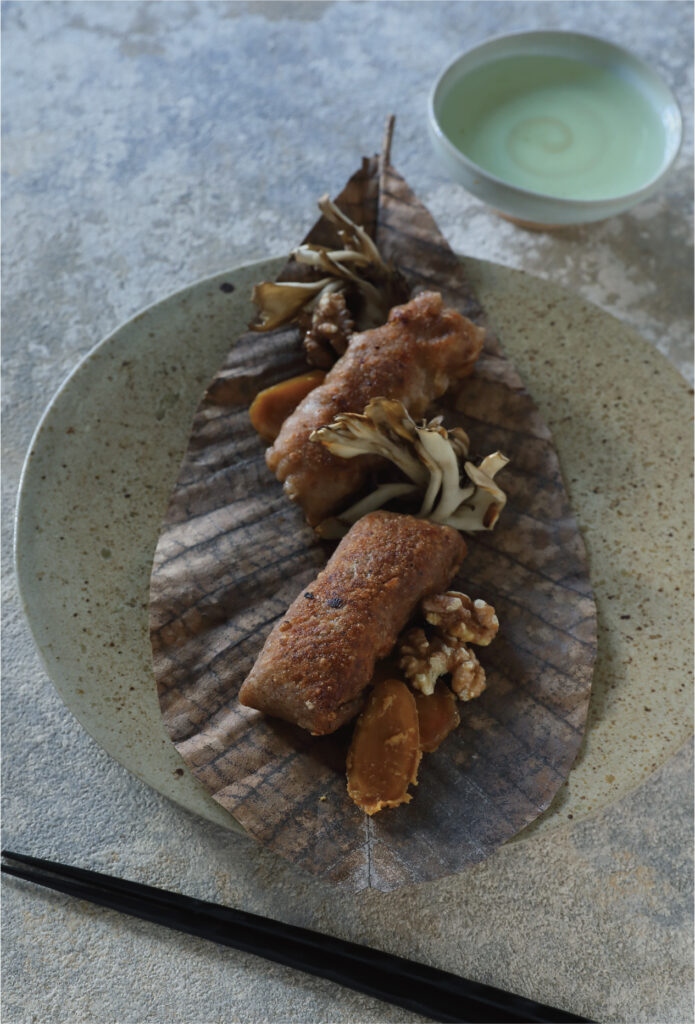
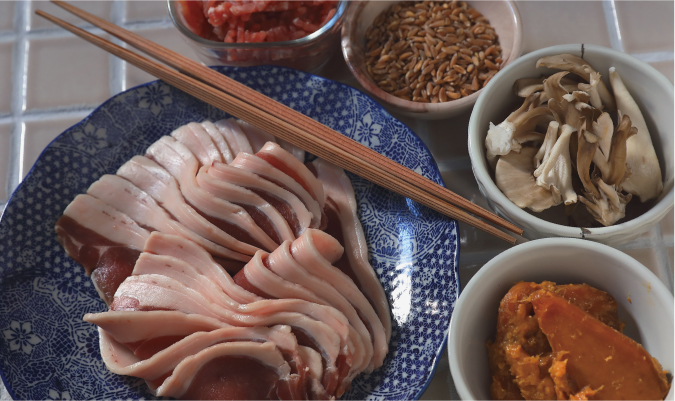
奈良らしさが息づいた餃子を創作するにあたって、松井まり子は奈良の歴史のなかでも特に力強い縄文・飛鳥時代に思いを馳せたという。ジビエと木の実、そして奈良伝統の風味を表現する奈良漬けと猪の肉を使い、餃子に奈良の文化を息づかせた。では、そのレシピをご紹介しよう。 具材:(皮)古代小麦と中力粉。(餡)猪、豚肉、生姜の奈良漬け、胡桃、舞茸。(盛り付け)胡桃と奈良漬けと餃子を朴葉の上に盛り付ける。
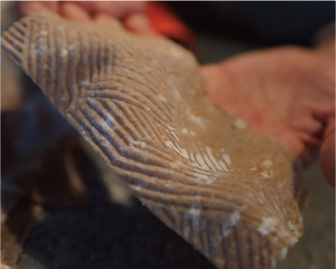
①古代小麦を炒ってからすり潰し粉にしたものと中力粉、水を合わせてよく練り、シート状にしてからローラーで模様をつける。
②猪、豚肉、生姜の奈良漬け、胡桃、舞茸、塩を混ぜて餡を作る。
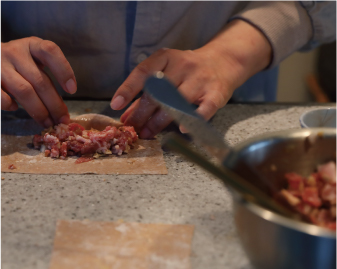
③皮で餡を包み、焼く。
④餃子と胡桃と奈良漬けを朴葉の上に乗せる。
さて、お味はいかがでしょう。
猪肉の主張が生姜の奈良漬けでうまく中和されていて、味のバランスが整っている。木の実の食感もいいアクセントになって味わいに豊かさをつくっている。和風といえば和風だし、どこか古い時代の名残を思わせる。なるほど、奈良らしい味だ。法隆寺の鐘の音を聞きながら味わいたい、そんな餃子。
Dumplings with Nara pickles and game meat—uniquely Nara.
In creating gyoza imbued with the spirit of Nara, I learned that Mariko Matsui focused on the powerful Jomon and Asuka periods of Nara’s history. She brought Nara’s culture to life in the gyoza by using gibier and nuts, along with narazuke (pickles preserved in sake lees) and wild boar meat, to express the region’s traditional flavor. Now, I will introduce the recipe.The ingredients for Nara-style gyoza are: the wrapper uses ancient wheat and medium-strength flour; the filling includes wild boar, pork, ginger narazuke, walnuts, and maitake. I will plate the gyoza, walnuts, and narazuke on a magnolia leaf (Hoba).① I knead roasted and ground ancient wheat with medium-strength flour and water to make the patterned wrapper. ② I mix wild boar, pork, ginger narazuke, walnuts, maitake, and salt for the filling. ③ I wrap and cook the gyoza. ④ I arrange the gyoza, walnuts, and narazuke on a magnolia leaf (Hoba).Now, how is the taste?I tasted the gyoza and found the strong flavor of the wild boar meat skillfully neutralized by the ginger narazuke, resulting in a well-balanced taste. The nutty texture provides a great accent, adding richness to the flavor. It has a distinctly Japanese feel, evoking remnants of an ancient era. I concluded that this is truly a flavor unique to Nara—a gyoza I would love to savor while listening to the bells of Horyuji Temple.
《料理家》 松井まり子 Mariko Matsui
株式会社De-De
Senior Art Director/Graphic Designer/Food Stylist
アートディレクター、フードスタイリストとして活動する傍ら2024年にはDe-De GYOZAもスタート。